
EB-5 Visa in 2026: What Investors Need to Know Before the September Deadline

Imagine spending years building wealth across borders, only to have a single legislative lapse freeze your U.S. residency application indefinitely, with no timeline, no recourse, and no clarity. That's exactly what happened to thousands of EB-5 investors in 2021, when the Regional Center Program expired overnight and USCIS suspended all pending cases.
Congress tried to prevent that from happening again. In 2022, it passed the EB-5 Reform and Integrity Act (RIA), and buried inside it is a protection clause that expires on September 30, 2026. Most investors focused on the programme's 2027 reauthorization date have entirely missed this earlier, more consequential deadline.
2026 is also the year USCIS formalised a completely new petition processing model. For investors currently in or entering the EB-5 pipeline, the landscape has shifted in ways that affect timing, project selection, and long-term strategy.
This article breaks down what's changed, what's at stake, and what the September deadline means for investors who are still deciding.
What Is the EB-5 Visa, and Who Is It For?
The EB-5 Immigrant Investor Program grants U.S. permanent residency to foreign nationals who invest qualifying capital into a U.S. business that creates at least ten full-time jobs for American workers.
There are two investment routes:
- Regional Center Programme, capital is pooled into a USCIS-designated project, with job creation counted indirectly. This is the route used by the vast majority of EB-5 investors.
- Direct Investment, the investor establishes or expands their own business and directly manages the job creation process.
The minimum investment thresholds currently stand at $800,000 for projects in Targeted Employment Areas (TEA), including rural and high-unemployment locations, and $1,050,000 for standard (non-TEA) projects. These figures are expected to increase in 2027 under statutory adjustment provisions of the RIA.
.jpg)
What Changed in 2026: The New USCIS Processing Model
How does USCIS now process EB-5 petitions?
On February 25, 2026, USCIS published a new inventory management approach for EB-5 petitions (Form I-526E), formalising how petitions are prioritised and assigned for processing across Rural, High Unemployment Area (HUA), Infrastructure, and Unreserved categories. It is the first time since the EB-5 Reform and Integrity Act of 2022 that the agency has published a formal processing framework.
Effective March 30, 2026, USCIS moved to a "project-first" FIFO (first in, first out) model. Under this approach, your position in the processing queue depends on two factors: the category of your project (rural, high unemployment, infrastructure, or unreserved) and the I-956F project approval status of the Regional Center you've invested in, not simply the date you filed.
The priority order is:
- Rural projects
- High-unemployment area (TEA) projects
- Infrastructure projects
- Unreserved projects
This means investors in rural projects now have a structural advantage in processing speed, regardless of when non-rural investors filed. It also means that project selection is no longer just a financial decision, it has direct implications for queue position.
What does "project-first" processing mean for investors in non-rural categories?
What the announcement does not address may matter more than what it says: there is still no published guidance on how approved petitions translate into actual visa allocations, the step that ultimately determines whether an investor receives a green card.
In practical terms, investors in unreserved categories, for example those from China and India, face the greatest uncertainty. While all three set-aside categories (rural, high-unemployment, and infrastructure) are currently current for all nationalities as of early 2026, the State Department has flagged that retrogression remains possible later in FY2026 for unreserved applicants from high-demand countries.
.jpg)
The September 30 2026 Grandfathering Deadline: What Every Investor Must Understand
What is the EB-5 grandfathering deadline?
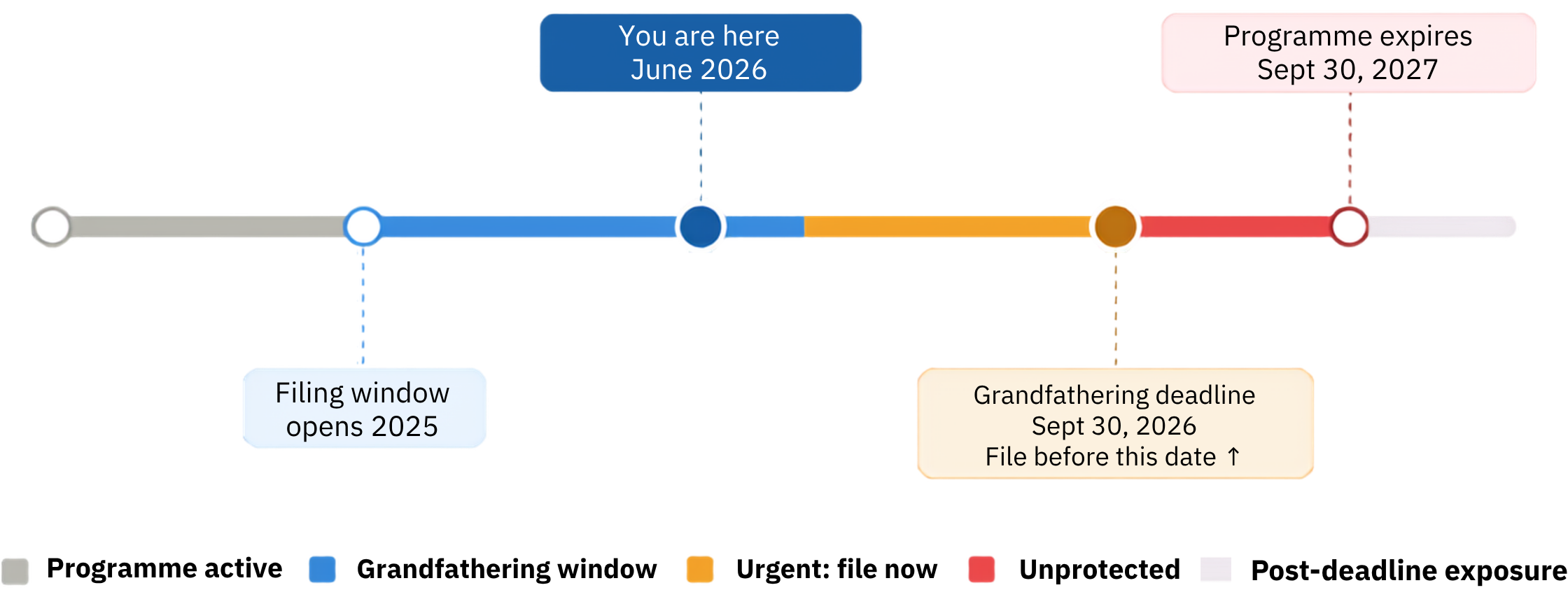
September 30, 2026 is one of the most important dates in the modern history of the EB-5 investor visa programme. Under the EB-5 Reform and Integrity Act of 2022, Congress created a grandfathering provision that protects certain EB-5 petitions from future programme lapses. That protection applies only to petitions properly filed on or before September 30, 2026.
Source: NatLawReview
Filing before that date protects your petition by law. Filing after that date removes those protections and exposes the case to future legislative uncertainty.
Why does it matter if the programme is authorised until 2027?
This is the distinction that trips up most investors. The EB-5 Regional Center Programme is authorised through September 30, 2027, but the grandfathering protection deadline is September 30, 2026. That's a critical distinction most investors miss.
Authorization and grandfathering operate on entirely different timelines. Authorization tells you when the programme is permitted to run. Grandfathering tells you when your petition becomes legally insulated against the consequences of any future lapse.
The 2021 freeze is the clearest illustration of why this matters. When the EB-5 Regional Center Programme expired on June 30, 2021, USCIS immediately suspended processing of all pending Regional Center petitions. Families who had already committed capital were left without clarity or a processing timeline.
Source: Greenville Chamber of Commerce
Congress designed the 2026 grandfathering clause specifically to prevent a repeat of that scenario. But that protection only extends to petitions received and accepted by USCIS before the deadline.
What does grandfathering actually protect?
Investors who file Form I-526E before September 30, 2026 secure several key protections:
- Their case continues to be processed even if the EB-5 Regional Center Programme lapses after September 30, 2027
- They are not left in a freeze waiting for Congressional reauthorization
- If Congress modifies or eliminates visa set-asides, their petition remains eligible under current rules
- They lock in the current $800,000 minimum investment, even if future legislation raises it.
Notably, the Child Status Protection Act provisions also apply, meaning dependent children's ages can be frozen at filing, preventing them from ageing out of eligibility during a prolonged processing timeline.
Does the petition need to be approved by September 30, 2026?
No. USCIS only needs to receive and accept a properly filed petition by September 30, 2026. Approval can come later. The filing date, not the approval date, is what determines grandfathering eligibility.
What Happens If You File After the Deadline?
Investors who file after September 30, 2026 are not protected under the grandfathering provision. If the programme lapses on September 30, 2027, their case could be put on hold indefinitely, with USCIS suspending processing until Congress acts.
Given that Congressional reauthorizations of the EB-5 programme have historically been contentious and intermittent, this is not a theoretical risk. It is the scenario that has already played out, and the one that the grandfathering clause was explicitly written to address.
Timing Considerations: Why Waiting Is Costly
Investors who wait until the second or third quarter of 2026 may find that the projects they want are full, that their preferred professionals are oversubscribed, or that source-of-funds documentation cannot be completed in time. USCIS processing capacity is finite, and as filing volume rises, processing times typically lengthen. Filing earlier secures an earlier receipt date and priority date, an advantage that cannot be replicated later.
Source-of-funds documentation is one of the most commonly underestimated parts of the EB-5 process. Tracing the lawful origin of investment capital across multiple jurisdictions, corporate structures, or years of transactions can take months. Investors who begin that process in Q3 2026 are taking on meaningful execution risk.
There is also the question of concurrent filing. Investors who are physically present in the United States at the time of filing are currently able to submit Form I-485 (Adjustment of Status), I-765 (Employment Authorization), and I-131 (Advance Parole) concurrently with their I-526E, allowing them to access work authorization and travel documents while their green card petition is pending.
Frequently Asked Questions
.jpg)
Yes. The EB-5 Regional Center Programme is currently active and authorised through September 30, 2027. All three set-aside categories, rural, high-unemployment, and infrastructure, are current for all nationalities as of early 2026, meaning there is no visa backlog in those categories at present.
.jpg)
The current minimum investment is $800,000 for projects in Targeted Employment Areas (rural or high-unemployment) and $1,050,000 for standard projects. These amounts are expected to increase in 2027 under RIA statutory adjustment provisions.
.jpg)
September 30, 2027 is when the EB-5 Regional Center Programme's current Congressional authorization expires. September 30, 2026 is the grandfathering deadline, the date by which petitions must be filed to receive legal protection if the programme lapses or changes after 2027. Both dates matter, but the 2026 deadline is more immediately consequential for investors.
.jpg)
Yes, though with important nuances. All nationalities are currently current for set-aside categories (rural, high-unemployment, infrastructure), which means no backlog in those queues. The retrogression risk is primarily concentrated in the unreserved category for high-demand countries. Indian applicants in the unreserved category have seen positive movement on priority dates in early 2026, but investors from China and India in unreserved categories should plan for potential delays and consider set-aside project categories accordingly.
.jpg)
No. Grandfathering does not change EB-5 eligibility rules. It does not guarantee approval or eliminate visa backlogs. Its purpose is to protect a pending case if Congress fails to renew the Regional Center Programme. Investors still need to meet all programme requirements, demonstrate job creation, and wait for visa availability. Colombo & Hurd
A Note on Programme Complexity
There is still no formalized shared understanding between USCIS and the National Visa Center on visa allocation, a gap in guidance that leaves investors facing critical decisions with incomplete information, and one that makes the 2026 grandfathering deadline increasingly urgent as it approaches.
This is the nature of EB-5: it is a statutory programme operating at the intersection of immigration law, securities regulation, and geopolitical visa demand. The structural complexity is real, and the consequences of timing errors can be significant. Investors navigating the programme benefit substantially from advisory support that spans both the investment and immigration dimensions of the process.
How Melbourne Capital Group Enterprise Can Help
MCGE works with high-net-worth investors and families evaluating U.S. residency through the EB-5 programme. Our advisory approach focuses on the full picture, programme mechanics, project due diligence, source-of-funds strategy, and timeline planning relative to key legislative deadlines like September 30, 2026.
If you are considering EB-5 and want to understand whether the current window still makes sense for your circumstances, we would welcome a confidential conversation.
Email me at shashanorazmi@mcgprivateoffice.com or connect with me on Linkedin.
This article is intended for educational and informational purposes only. It does not constitute legal, immigration, or investment advice. Visa eligibility and programme terms are subject to change. We recommend consulting qualified immigration counsel and financial advisers before making any investment decisions.
.webp)
Explore our Insights
Our team of global experts share their perspective on markets and news from the company.
.jpg)

.jpg)