
Greece Golden Visa 2027 Changes: What the New Property Transfer Tax Could Mean

Prime Minister Kyriakos Mitsotakis announced plans to increase the property transfer tax for non-EU buyers from 3% to 15%. The Prime Minister's initial announcement referenced 1 January 2027 as the start date, but Greece's Ministry of National Economy and Finance has since clarified the proposed effective date as 1 July 2027.
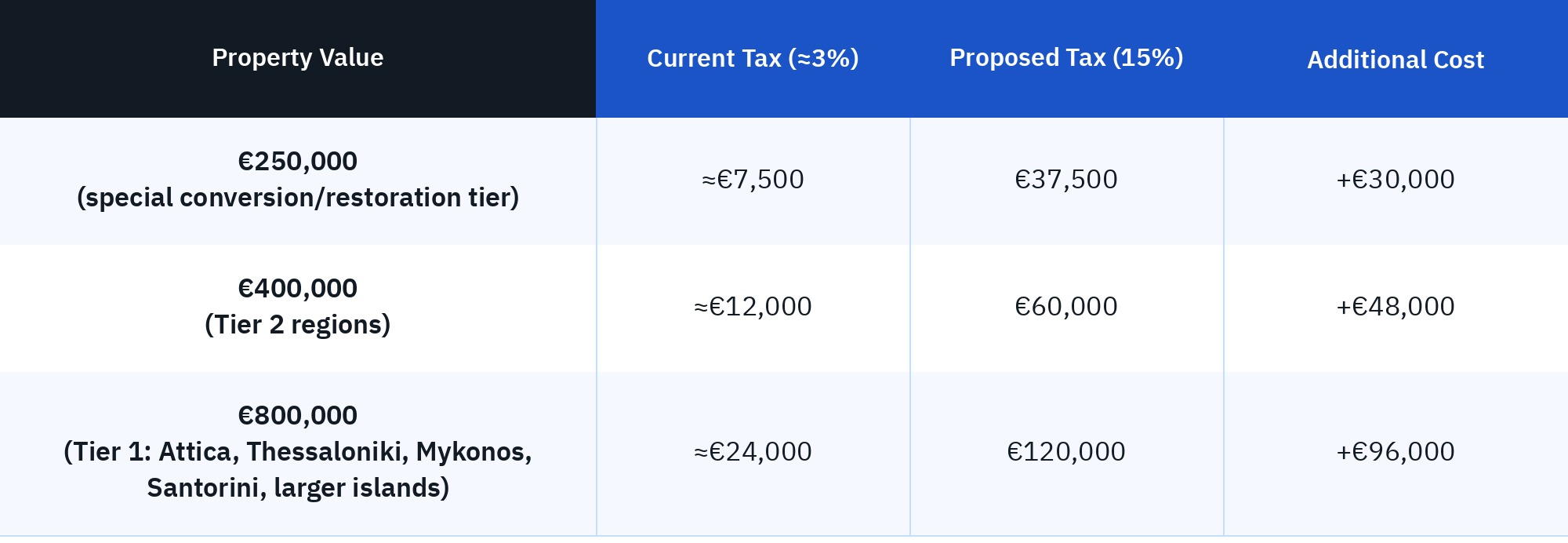
If you've been weighing a Greece Golden Visa application, or you're partway through one already, this is worth understanding properly rather than reacting to headlines. Take an investor eyeing a €400,000 property in one of Greece's Tier 2 regions: under current rules, transfer tax adds around €12,000 to the purchase. Under the proposed 15% rate, that becomes €60,000, a difference that changes the overall cost calculation for the investment, even though the residency thresholds themselves haven't changed. Below is what's been announced, what's still uncertain, and what it could mean depending on where you are in the process.
What Is Changing to Greece's Property Transfer Tax?
On 6 September 2026, at the Thessaloniki International Fair, Prime Minister Mitsotakis announced that Greece's property transfer tax for third-country nationals, buyers who aren't EU citizens, will rise from around 3% to 15%. The Prime Minister's announcement referenced 1 January 2027 as the start date, but Greece's Ministry of National Economy and Finance has since indicated the proposed effective date is 1 July 2027. The measure is part of a wider EUR2.2 billion housing affordability package and specifically targets foreign buyers, with the Prime Minister referencing buyers from countries including China, Turkey, and Israel.
How Much More Would Golden Visa Investors Pay?
At the proposed 15% rate, transfer tax on a Greek property purchase would roughly quintuple compared with the current rate, adding tens of thousands of euros to the cost of an investment depending on the property value and the Golden Visa tier it falls under.
Why Is Greece Raising the Tax Now?
The Greek government has framed the increase as a housing affordability measure, arguing that foreign investment demand has made it harder for Greek residents to buy homes in high-demand areas. The tax rise sits within a broader €2.2 billion housing package, and officials have described it as intended to act as a disincentive for foreign buyers in the most pressured markets, rather than as a change to the Golden Visa's residency framework itself.
This places Greece alongside several other European countries that have tightened the property-investment route to residency in recent years. Portugal, for instance, removed real estate as a qualifying Golden Visa investment category in 2023. The rationale in each case has generally centred on domestic housing pressure rather than a retreat from foreign investment as a whole.
Could the €250,000 Threshold Be Treated Differently?
It's possible, but not yet confirmed. Greece's existing €250,000 Golden Visa tier applies specifically to properties being converted from commercial to residential use, or listed buildings undergoing restoration. These are investments that add to Greece's housing stock rather than competing for existing homes. Some legal commentators, including Golden Visa-focused law firms, have publicly argued this category should be exempted from the new 15% rate, on the basis that it funds regeneration and new housing supply rather than displacing local buyers.
That argument hasn't yet been reflected in any published legislation. Until the implementing law is released, investors considering the €250,000 route should treat a possible carve-out as an open question rather than an assumption to plan around.
What About Buyers Already Mid-Purchase?
This is one of the least clear parts of the announcement. Legal commentators have flagged several unresolved questions: what point in a transaction would "lock in" the applicable rate? The preliminary agreement, the tax payment, or the notarial deed? And whether buyers with agreements already signed before the new law takes effect would receive any transitional protection.
Until the legislation is published, anyone currently mid-transaction, or close to signing, should treat the timeline as uncertain and confirm their specific position with a Greek-qualified lawyer or notary rather than assuming any particular outcome.
Is the Greece Golden Visa Programme Itself Changing?
Not based on what's been announced so far. The investment thresholds and zones set out in the 2024 reforms:
- €800,000 for Attica, Thessaloniki, Mykonos, Santorini and larger islands
- €400,000 for the rest of Greece;
- €250,000 for qualifying conversion or restoration projects
These remain the current framework. This announcement is about the transfer tax paid on top of the investment, not the investment threshold itself. For a full rundown of those thresholds and how the programme works, see our earlier article, Greece's 2024 Golden Visa Programme: Latest Changes.
If you're considering the Greece Golden Visa and want to understand what this change could mean for your situation, email me at shashanorazmi@melbournecapitalgroup.com or connect with me on Linkedin. I’m happy to point you towards the right specialist to talk it through.
Common Questions About the Greece Golden Visa 2027 Changes
Will the higher tax apply if I already own Golden Visa property in Greece?
No. This is a transfer tax paid at the point of purchase, not an ongoing property tax, so it wouldn't apply retroactively to a property you already hold. The open question is around transactions still in progress when the law takes effect, not completed purchases.
Does the 15% rate apply to EU citizens buying property in Greece?
No. The proposed increase is specifically targeted at third-country (non-EU) nationals, which is why it has particular relevance for Golden Visa applicants, who must be non-EU nationals to qualify for the programme in the first place.
Should I rush to complete a purchase before the legislation is finalised?
That's a decision that depends on your personal circumstances, timeline, and risk tolerance, and it's worth discussing with a qualified immigration and tax adviser rather than deciding based on headlines alone, particularly while the transitional rules remain unpublished.
Are there other costs involved in a Greece Golden Visa application beyond the transfer tax?
Yes. Beyond the property price and transfer tax, applicants typically factor in legal and notary fees, government application fees, and ongoing costs of holding the property. A specialist adviser can walk through a full cost picture for your specific investment tier.
A Fast-Moving Situation Worth Watching Closely
Greece's Golden Visa programme has been reshaped several times since 2023, and this proposed tax change is the latest example of how quickly the rules around European residency-by-investment can shift. As with any investment migration programme, applications remain subject to due diligence and government review, and investment thresholds and conditions can change, so it's worth verifying the latest requirements through official sources or a qualified investment migration adviser before making a decision.
Tax and regulatory rules vary by jurisdiction and are subject to change; this article is for general information only and should not be relied upon as financial, investment, tax or legal advice. Investment involves risks and past performance is not indicative of future results. Independent professional advice should be sought before making any investment or residency decision.

Explore our Insights
Our team of global experts share their perspective on markets and news from the company.